
The use of net wrap on hay bales can be beneficial to your farm. They help to increase the productivity of your baling process, reduce the loss of nutrients from the hay, and retain more leaves for a higher quality of grass. But they are not very biodegradable and can’t be recycled.
 Increased productivity
Net wrap is an excellent way to increase the productivity of baling. It has several advantages over twine, including faster and easier wrapping, less water loss during baling, better aesthetics, and greater marketability.
A study by the American Society of Agricultural and Biological Engineers (ASABE) found that using net wrap instead of twine increases bale production by 32%. It significantly reduces time, energy, fuel and labour costs. The results also revealed that the net-wrapped bales had a lower moisture content than the twine-tied bales.
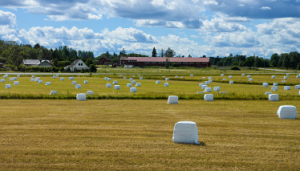
One of the main advantages of net wrap is the ability to store hay and silage outdoors. When wrapped, the bale is more stable in all storage conditions, reducing losses. In addition, the bale maintains its shape, is easier to handle, and retains more leaves.
The research also showed that the wrapped bales were higher quality and more attractive to consumers. In addition, they had better visual appeal and lower moisture and mould counts than the twine-tied bales.
While net wrap may be more expensive than twine, it is worthwhile because it can help farmers keep more money in their pockets. Furthermore, it can help improve cattle’s health and enhance forage’s nutritional value.
A net wrap can also reduce the amount of animal forage waste, directly affecting feed quality. Research has shown that post-harvest losses of animal feed can affect the quantity and quality of feed produced.
Retains more leaves for higher-quality hay
When it comes to hay, the task of harvesting and storing it can be a daunting one. In maximising yields, the crop must be harvested at the optimal time of year and the right temperature and moisture levels. Likewise, the crop needs to be inspected for pests or weeds or wasted effort. Finally, a discerning eye should also be kept on the condition of the hay. The nutritional value will drop like a stone if the leaves are too dry or the grass is stale. Thankfully, there is a plethora of information available online to assist in avoiding a costly mishap.
The most crucial step in the process is to avoid premature shedding. As a result, it is a good idea to keep the leaves intact as much as possible. Keeping the leaves from wilting in the heat of the moment will save you the headaches and the kilowatts of electricity required to replace the hay that has dried up in the back of the truck. In other words, the best way to slay the foraging flies is to make the hay as close to its original state as possible. It will ensure the best chance of producing top-quality hay.
Reduces nutrient loss
Net wrap is a good idea on multiple fronts. It reduces the cost of handling hay, minimises equipment wear, and allows you to bale more grass quickly. While you’re at it, why not save a few bucks on fuel? If you squeeze it in during harvest season, you’ll be rewarded with more hay for the same price.
While you’re at it, consider getting a net wrap Adelaide baler. These are especially useful for large acreage producers and custom operators. They save you from tedious tasks such as manually wrapping bales and allow you to concentrate on slicing, stacking and sprinkling hay. Also, they’re a bit more fuel-efficient than your standard twine baler, so you’ll see a noticeable reduction in overall fuel consumption. You’ll also find that net-wrapped hay is more stable in storage, improving the odds of a good harvest.
The name of the game, though, is deciding which one to choose. Luckily, the experts at Kansas State University have given us a rundown of what to look for. And, while there’s no guarantee that you’ll get the best deal, a little research should go a long way. Ultimately, depending on your hay storage needs, you’ll want to decide on the net wrap or twine.